
Every takeaway owner has a story about a supplier letting them down. The delivery that arrived on Monday instead of Friday. The box of patties that were a different size from the last box. The “halal” burger that turned out to have no certificate behind it when a customer asked.
The patty is the centre of the plate and the single biggest line on a burger shop’s food cost, so the supplier behind it matters more than most operators give it credit for. Get it right and your burgers taste the same every night, your margins stay fixed and you never have to apologise to a customer. Get it wrong and you are firefighting every week.
This is a ten-point checklist for choosing a frozen burger supplier, written for anyone opening a takeaway, switching supplier or adding burgers to a menu for the first time. It applies whether you buy wholesale burgers by the pallet or a few cases a week.
A frozen burger is a simple product, which is exactly why consistency is the whole game. Customers do not notice a good burger being good; they notice it being different from last time. A supplier that changes manufacturer, pack size or recipe without telling you is costing you repeat trade even if the price never moves.
Three things sit behind consistency: the manufacturer’s process, the supplier’s cold chain, and the supplier’s honesty about what is in the box. The checklist below is built around those three.
If you serve a halal customer base, this is the first question, not the last. Ask which certification body covers the patties, whether the certification follows the product through the supplier’s warehouse, and whether the label is on the case you receive. HMC is the body a large share of UK customers ask for by name. BurgerPro’s beef patties carry HMC in the product name on the site, from the HMC 57g Butcher Smash Burger to the HMC 170g Gourmet 100% Beef Burger, and the label is on the box.
A supplier that answers “it’s halal” without naming the certifier is giving you something you cannot repeat to a customer.
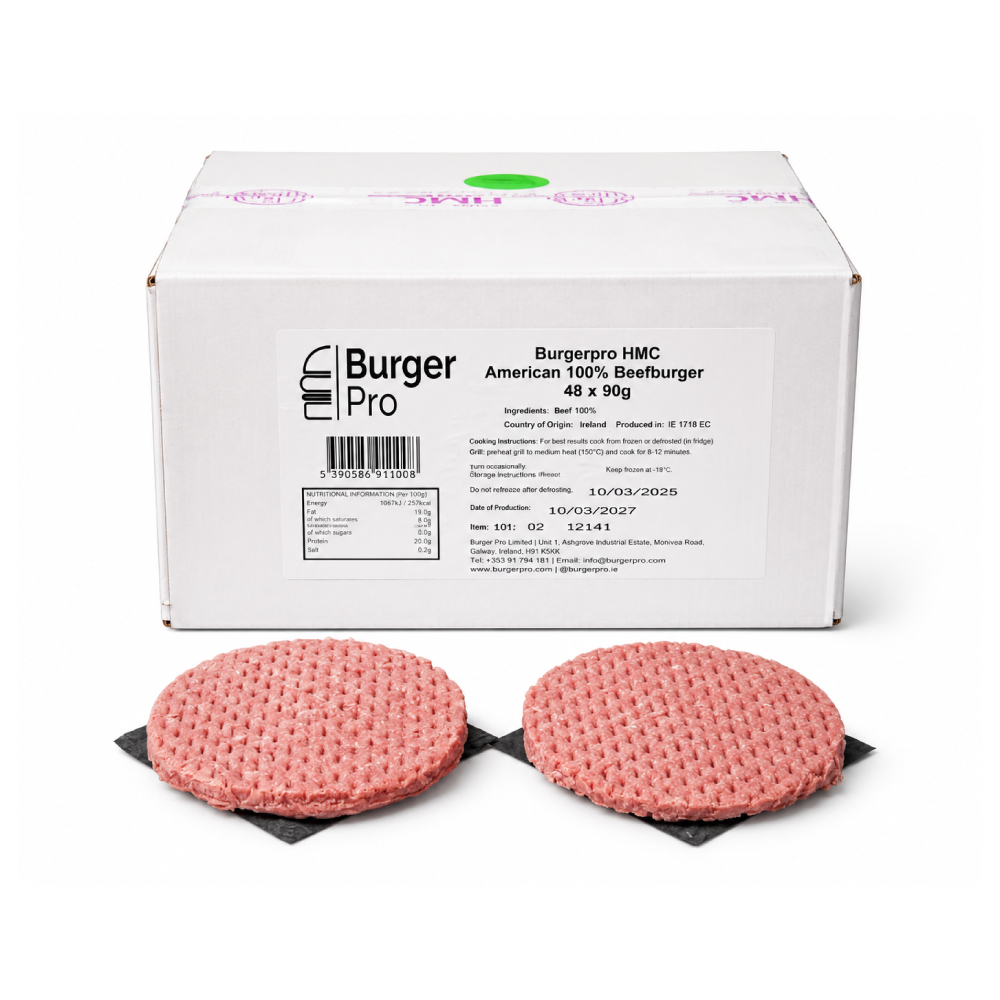
The best frozen beef burgers have very little in them. Look for the beef percentage and what makes up the rest. BurgerPro’s smash and gourmet patties are listed as halal beef 99%, salt and pepper, and the classic 45g and 90g rounds as beef 100%, with no allergens declared in the ingredients. A supplier that cannot show you the ingredient list on a product page, or whose patties carry a long list of fillers and binders, is selling you a cheaper product than the price suggests.
The ingredient list also matters for your allergen matrix. Fewer ingredients means fewer things to check every time a customer asks.
Do not design your menu around a supplier’s single patty size. Decide what you want to sell, then find a supplier with the sizes to do it. A smash menu needs 57g (2oz) patties for doubles and triples, 70g (2.5oz) as a flexible middle, and perhaps 85g (3oz) for a single. A kebab house or chip shop selling quarter-pounders wants a 90g round. A kids’ meal or slider wants 45g. A premium signature burger wants something like 170g.
BurgerPro’s frozen burger range covers all of those, plus Angus versions of each smash size. If a supplier only offers one or two sizes, your menu is being decided for you.
Ask how many patties come in a case and what the case weighs. A shop doing 300 burgers a week does not want to hold six weeks of stock, but it also does not want to order every three days. As a reference, BurgerPro’s 57g and 45g patties come 150 to a case, the 70g smash patties 120, the 85g smash patties 90, the 90g rounds 48 and the 170g gourmet patties 40. Case weights are listed on each product page so you can check what fits in your chest freezer before you order.
Pre-formed, individually frozen patties should be the same weight every time, which is what fixes your food cost per burger and your cooking time. Ask whether the patties are formed to a stated weight and whether the manufacturer has changed in the last year. If you can, order a single case before committing and weigh a handful. Our smash burger recipe for takeaways explains why pre-formed pucks beat hand-balled mince for a takeaway griddle.
A patty that cooks well straight from frozen on a flat-top saves you labour, freezer-to-fridge planning and waste. Look at shrinkage (how much the patty pulls in), fat release (enough to crisp the edges, not so much that the griddle floods) and how the patty holds together when pressed. A trial case on your own equipment tells you more than any product sheet. It also needs to taste good served simply, in a plain bun with a slice of cheese, before any sauce goes near it.
Frozen food lives or dies on the cold chain. Ask how orders ship, how long dispatch takes, whether you get tracking and what happens if a delivery arrives soft. BurgerPro dispatches within 1 to 2 working days through several logistics partners with tracking on every order, from its warehouse in Saltley, Birmingham to anywhere in the UK. Whatever supplier you choose, the dispatch promise should be in writing on their site, not just in a phone call.
Good frozen burger sourcing means balancing product quality with volume pricing and ordering flexibility. Some operators want a trade account with scheduled deliveries. Others want to buy a case online at 11pm after a busy Saturday and have it arrive midweek. A good supplier does both. BurgerPro sells by the case through its online shop and handles trade volumes, case quantities and pricing through the wholesale enquiry form, so you are not locked into a minimum before you have tried the product.
Be wary of any supplier that will not tell you how ordering works until you have signed up.
The fewer suppliers you manage, the fewer deliveries you chase. A burger supplier that also carries the sauces, fries, rashers and chicken that go around the patty saves you time every week and makes it easier to keep the whole menu consistent. BurgerPro stocks Nawhal’s and Colona sauces, Aviko fries, HMC rashers and brisket and breaded chicken alongside the patties, which means a bacon cheeseburger, a brisket burger and a chicken burger can all come off one order.
A supplier who publishes ingredients, allergens, case counts and case weights on every product page is a supplier you can check on at 2am. One who makes you phone for the basics is one you will end up guessing about. Before you commit, read the product pages for the patties you plan to use and see whether the information you need is actually there.
A few warning signs are worth a direct question before you order.
No certifier named, only the word “halal”. A price that is well below everyone else’s, which usually means a lower beef percentage or a smaller patty than advertised. No ingredient list online. A supplier that cannot tell you where the patties are manufactured. “Price on application” for everything, including a single case. And any supplier that has changed manufacturer recently and did not mention it.
None of these is automatically a deal-breaker, but each one is a reason to ask more questions before the patties become the centre of your menu.
Operators sometimes assume fresh mince is the premium choice. For a takeaway griddle, pre-formed frozen patties usually win on portion control, labour, waste and food safety, and they let you offer a smash burger or a quarter-pounder without a prep cook forming patties at 4pm. The quality difference comes from the beef percentage and the manufacturer, not from whether it was frozen. Our post on what is burger sauce covers the other half of the burger, and the burger sauce pairings guide matches sauce to patty.
BurgerPro began in 2019 in a small warehouse in Leicester and now supplies takeaways, burger bars, chicken shops, kebab houses, food trucks and caterers across the UK from Saltley, Birmingham. Customers can choose from a range of burger options, from the HMC 45g Beef Burger 100% and HMC 90g Beef Burger 100% through the smash sizes to the 170g gourmet patty, with a Premium 100g Fish Burger and a Halal 100g Philly Steak for menus that want more than beef.
Every product page lists ingredients, allergens, units per case and case weight. Orders dispatch within 1 to 2 working days with tracking. Single cases are available online; trade pricing and case quantities come through the wholesale enquiry form. The range suits fast-food businesses that need consistent frozen burgers without committing to one fixed specification.
Named certification, a short published ingredient list, the patty sizes your menu needs, case counts that fit your volume, consistent patty weights, good cooking performance from frozen, a clear dispatch and delivery promise, flexible ordering, and ideally the sauces and sides on the same order.
Yes, and for most takeaways they are the better choice. Pre-formed frozen patties fix your portion size and food cost, cook straight from the freezer and remove a prep job. Quality comes from the beef percentage and the manufacturer rather than from fresh versus frozen.
It varies by size and by supplier, so check the product page. At BurgerPro, 45g and 57g patties come 150 to a case, 70g smash patties 120, 85g smash patties 90, 90g rounds 48 and 170g gourmet patties 40. Each product page lists the count and case weight.
Minimums and trade pricing vary by supplier and volume. BurgerPro sells single cases online and confirms trade quantities and pricing through its wholesale enquiry form rather than publishing a fixed minimum.
The beef patties carry HMC certification in the product name and the HMC label on the case. Check the individual product page for any product that does not carry HMC in its name, such as the fish burger.
BurgerPro dispatches within 1 to 2 working days with tracking, using several logistics partners for nationwide UK delivery. Ask any supplier for their dispatch promise in writing.
Yes. Single cases through the online shop suit food trucks, pop-ups and caterers with limited freezer space, and the wholesale form is there once volumes grow.
Run your current supplier, or the one you are considering, through the ten points above. If more than two or three come back as “not sure”, it is worth a trial case from someone who can answer all ten. Browse the BurgerPro frozen burger range, order a case online to test on your own griddle, and complete the wholesale enquiry form when you are ready to talk case quantities and trade pricing.